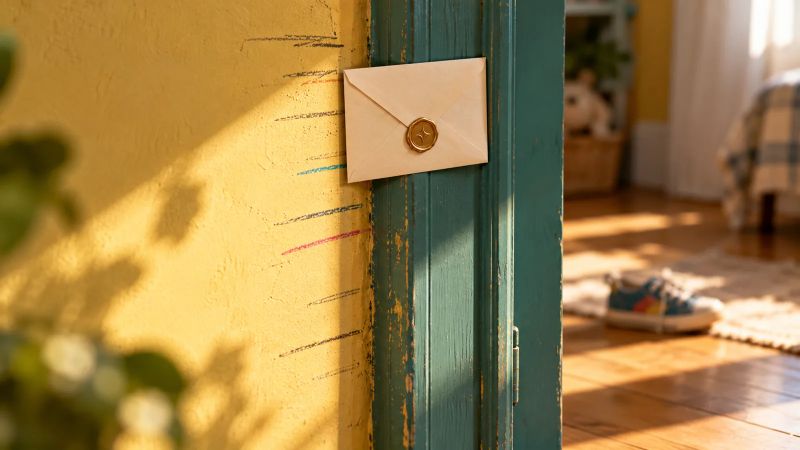
Most parents mean to write this letter someday. Usually "someday" means the night before graduation, or the morning they leave for college, when there's too much to say and no time to say it. By then you're writing from the end of the story.
There's a better time: now, while they're still small, or still a teenager who barely talks to you, and you can't see how any of it turns out. A letter to your son or daughter written today, to read when they're 18 or older, holds something no later letter can: who they were, and who you were, before either of you knew how it would go.
The kind of letter I mean
Before the how-to, here's an example. It's invented, written by a dad to his six-year-old.
Sam,
You're six. It's a Wednesday in March and you're asleep upstairs with the hallway light on, because last week you decided the dark has "too much in it."
Right now you want to be a garbage truck driver. Not the person who drives it. The truck. You've asked me four times this week why the moon follows the car, and I don't have a good answer.
We live in the yellow house on Maple, the one with the bad gutters. Saturdays are pancakes, then the park, then you fall asleep in the car on the way home and I sit in the driveway for ten minutes so I don't wake you up. Those ten minutes are some of the best of my week. You won't remember them.
I'm 38. I work too much and I know it. I'm worried about whether we can stay in this house, and whether I'm too short with you in the mornings. I am, sometimes. I'm working on it.
I don't know who you'll be when you read this. I hope you still ask why about everything. I hope you have one friend you can call at 2 a.m. That's it. That's the list.
Love, Dad
The hallway light, the garbage truck, a parent who admits he's short-tempered in the mornings. It asks for almost nothing, so an eighteen-year-old can read it without feeling graded.
Why write it now instead of waiting
Because the details disappear. You think you'll remember the way they said "lellow" or the year they insisted on wearing a cape to the grocery store. You won't, not precisely. Children change so fast that every version of them gets overwritten by the next one, and the parents who were there for each version get overwritten too.
Your kid will have thousands of photos. What they won't have is your side of it: what you were worried about, what made you laugh, what you were getting wrong and knew you were getting wrong. That's what a letter keeps.
What to put in it
- What they're like right now, in small details. Not "you're kind and funny"; everyone's kid is kind and funny. The stuffed animal with the chewed ear, the question at dinner you still think about, how they say goodnight, what scares them. Small details are exactly what an adult can't reconstruct about their own childhood.
- What the family is like. Where you live, what a Saturday looks like, the running jokes, the car with the broken heater, who comes for Thanksgiving. They'll remember some of it from a child's height. You can give them the view from yours.
- Who you are at this point. Most parents skip this, and grown children value it most. Your age, your job, what's worrying you, what you're unsure of. Kids grow up seeing their parents as finished people. Finding out you were thirty-six and making it up as you went is a gift.
- What you hope for them, carefully. "I hope you become a doctor," or even "follow your dreams," reads at eighteen like an expectation. Stick to hopes that don't require them to become anyone in particular: "I hope you have one friend you can call at 2 a.m."
What I'd keep out
Career or life expectations, first. They'll be in the middle of working that out, and the letter shouldn't be one more voice with an opinion. Adult conflicts too: you can say a year was hard without handing over the transcript of the divorce or the money fights. Promises like "I'll always be there" are true as a feeling and impossible as a fact, so describe instead.
And go easy on guilt. A letter that's mostly apology makes the reader responsible for reassuring you. Name one regret if you need to, then move on.
When should they read it?
Eighteen is the classic, and it works, though it lands in a season of big decisions, so reread it for anything that sounds like instructions. Some other options:
- At 25 or 30, when they may be thinking about their own life, maybe their own kids. Reading a parent at the same age, with the same doubts, hits differently.
- At a moment rather than a date: first apartment, wedding, first child. Harder to schedule, so you'll need someone you trust to pass it on.
- Several short letters instead of one, written every year or two and all sealed for the same day. Easier to write, and together they show both of you changing.
If you don't know where to start
Start with the last thing they said that made you laugh. Write it down exactly, with the date. Then write what you were doing when they said it. That's usually enough to get going. For more starting points, these letter prompts work just as well for writing to your kids.
A few practical things
- Write it by hand if you can. Your handwriting will mean something to them later. Keep a digital copy.
- Date it, including the year.
- Decide who keeps it. A drawer survives some moves and not others. A scheduled letter doesn't depend on anyone remembering.
- If both parents write one, write them separately. Two different views of the same kid are better than one compromise.
None of this is advice, really. What you're leaving is proof that someone watched them closely and loved them specifically, without knowing how it would turn out. If you don't trust a drawer to last eighteen years, you can write it on Letter to the Future and set the delivery date.
Did you enjoy this article?
Share it with your friends and help us reach more people