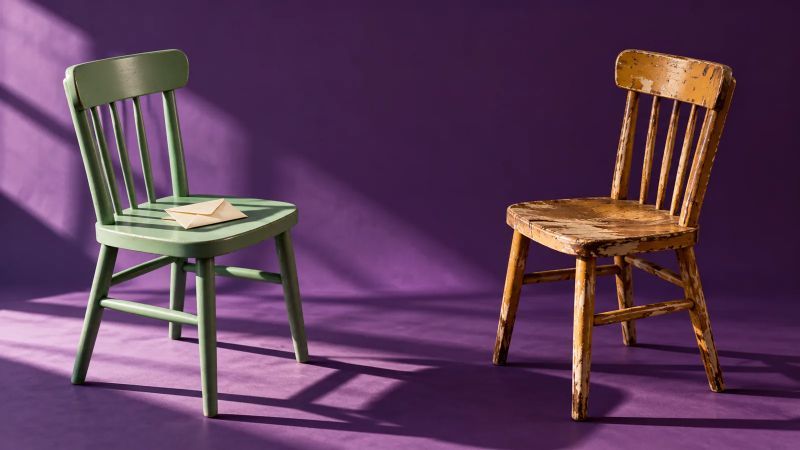
A letter nobody else will read, sealed for a year, addressed to a person who doesn't exist yet. Put like that, it sounds like a nice little craft project for your feelings and not much more.
I get the skepticism. I run this site, and for a long time I still wondered whether there was anything behind it besides a warm moment at the kitchen table. So here's what the research says, where it gets overstated, and what a letter like this is actually good for.
Your brain treats future you like a stranger
Hal Hershfield, a psychologist now at UCLA, has spent years studying what he calls future self-continuity: how much you feel that the person you'll be in ten or twenty years is still you.
In brain-imaging studies from his group, thinking about yourself far in the future produced activity that looked more like thinking about another person than like thinking about yourself today. And people whose "future self" looked closer to their "present self" in the scanner tended to have saved more money in real life. That's a correlation, not proof of cause. But it raises an obvious question: can you close that gap?
His best-known experiment, published in the Journal of Marketing Research in 2011, tried. Participants saw an age-progressed image of their own face at around seventy, then decided how to split a hypothetical paycheck between spending now and saving for retirement. The ones who had met their older face put noticeably more toward the future.
See the person you'll become, and you start treating them better. That's the whole idea in one line.
A letter does something similar
You don't need VR or face-aging software. In 2013, van Gelder, Hershfield and Nordgren published a study in Psychological Science in which 114 young adults wrote a short letter to themselves: half to who they'd be in three months, half to who they'd be in twenty years.
Afterward, the twenty-year group was a bit less willing to pick unethical options in a series of scenarios. The effect was small and borderline in statistical terms, so I wouldn't build a life philosophy on it. But it points somewhere interesting: writing to your distant self makes that person feel real for a while. And people who feel real get taken into account.
Notice when that happens. Not when you open the letter. When you write it.
The other half: what writing itself does
There's an older line of research here. In 1986, James Pennebaker and Sandra Beall had college students write for fifteen minutes a day, four days in a row, about the most upsetting experience of their lives. A control group wrote about neutral topics. Over the following months, the first group made fewer visits to the campus health center.
That study kicked off decades of work on expressive writing. Later reviews are more sober: the benefits are real but modest, they don't show up in every study, and they depend a lot on who is writing and why. Writing about what weighs on you helps a lot of people a little. It isn't treatment, and if you're going through something serious you deserve more than a notebook.
Still, the original instructions translate nicely to a letter: write about your deepest thoughts and feelings, forget about spelling and grammar, don't stop to fix things, and remember that nobody else will read it.
What it won't do
- It won't hit your goals for you. "Next year I'll have a new job" changes nothing on its own. It records that this mattered to you. That's something, but it isn't a plan.
- It won't predict anything. Most of what you guess about next year will be wrong. That turns out to be one of the best parts of reading it later.
- It won't replace therapy. It can sit alongside a process. It can't be the process.
- It won't work if you write for an audience. The moment you picture someone else reading it, the letter gets polished. Polished ages badly.
So what is it for?
Keeping who you were, not just what happened
Your photos, messages and calendar already record what you did. Nothing records what it felt like to be inside your head this March. And that disappears fast, because memory rewrites itself with whatever came next. If things turned out fine, you'll remember being optimistic. If they didn't, you'll remember seeing it coming. Usually neither is true. A letter written in the moment is the only unedited version.
Naming something that doesn't have a name yet
That low hum of unease you've been carrying around for weeks? Writing forces it into sentences, and sentences force you to decide what you mean. Plenty of people find out what's going on with them in the third paragraph, not the first.
Asking questions only your future self can answer
This is my favorite reason, and it only works in letter form. "Are you still with her?" "Did you take the job?" "Was that thing keeping you up in September actually a big deal?"
Reading those a year later is strange and surprisingly moving. Mostly because you get to check whether the problem that filled the whole screen back then is still there. Usually it isn't. Do that a few times over a life and your relationship with your own emergencies starts to change.
A short example
This one was written for this article; it isn't from a user. Letters on the platform are private unless the writer chooses to publish them anonymously.
Hi.
It's 7:30 on a Tuesday morning in October and I've been up since five. That happens a lot lately. No specific problem, just background noise I can't turn down.
Work is fine and I don't like it. Both at once. I'm good at it, I've wanted out for months, I have no idea what I'd do instead, so I stay. Every month I stay, leaving gets a little harder to picture.
Dad has his checkup in January. I'm more worried than I'm letting on to anyone.
Questions for you: Are you still at the same place? Did you ever talk to Sam about the project, or did you let it die like always? Did you make it to Portugal? Are you sleeping?
I don't have advice for you. You know more than I do. I just wanted you to know that this morning, with cold coffee and no sleep, someone was thinking about you kindly.
If you want to try it
Pick a timeframe first. One year works for almost anything. Six months if you're in the middle of a decision. Five years if you want the odd experience of meeting a stranger who turns out to be you.
Then write without editing. If you're stuck, there's a list of letter prompts to get you going, a few example letters, and a breakdown of what to include in a letter to your future self.
One last thing people forget: don't reread it before you send it. It isn't for you right now.
You can write yours on Letter to the Future. Pick the delivery date, and until then nobody reads it. Not even you.
Did you enjoy this article?
Share it with your friends and help us reach more people